


Table of Contents
- Why do businesses hire virtual assistants?
- When hiring a virtual assistant makes business sense
- How do you know when it's time to hire a virtual assistant?
- What should you delegate to a virtual assistant?
- When does hiring a virtual assistant not make sense?
- Do you need a virtual assistant or another type of hire?
- Why hire a Filipino virtual assistant?
- Why hire a virtual Executive Assistant instead?
- What is the business case for hiring a virtual assistant?
- How HeyVA helps you hire a virtual assistant
- Decide based on where your time is going
- FAQs
Why hire a virtual assistant? A virtual assistant can take ownership of recurring work that consumes your time but doesn't require you personally to do it. Businesses hire VAs for administrative support, scheduling, customer communication, research, reporting, CRM updates, and other repeatable responsibilities, giving founders and managers more capacity for work that depends on their judgment or expertise.
The decision shouldn't come down to whether you're busy. Look at what is taking your time, whether someone else could own it, and what you could focus on instead.
If routine work is regularly competing with sales, client work, strategy, or other priorities, hiring a virtual assistant may make business sense.
Key takeaways
- A virtual assistant can take ownership of recurring work that doesn't need to remain with a founder or senior team member.
- Hiring a VA makes more sense when you can clearly define what the person will own and what good performance looks like.
- A VA can add capacity without every new responsibility requiring another traditional role.
- The best tasks to delegate have clear outcomes and can be completed remotely.
- A VA may not be the right hire when the work requires physical presence, specialist qualifications, or significant strategic authority.
Why do businesses hire virtual assistants?
Businesses hire virtual assistants to create capacity by moving suitable recurring work away from people whose time is needed elsewhere.
For a founder, that could mean delegating calendar administration, research, CRM updates, or follow-ups instead of fitting them between sales calls.
An agency might need someone to coordinate meetings or maintain internal systems while account managers focus on clients. An e-commerce business might need support with customer communication or day-to-day operations.
The common factor is that the work needs to happen, but it doesn't necessarily need to be done by the person currently doing it.
That makes the decision less about finding ‘extra help’ and more about assigning the right work to the right person.
When hiring a virtual assistant makes business sense
Get recurring work off your plate
Small tasks become expensive when the wrong person keeps doing them.
Updating spreadsheets, organizing calendars, researching information, managing an inbox, and entering CRM data may each take only a few minutes. Together, they can consume a meaningful part of the week.
Look for work that follows a repeatable process.
If you can explain the expected outcome and someone else can complete the task to the required standard, ask whether it still belongs on your personal task list.
The goal isn't to delegate everything. It's to identify work that no longer requires your direct involvement.
Give recurring work a clear owner
Some tasks get delayed because nobody is clearly responsible for them.
A customer follow-up waits until tomorrow. The CRM becomes outdated. Meeting notes don't turn into action items. A weekly report gets prepared only when someone remembers it.
A virtual assistant can take responsibility for defined workflows rather than simply ‘helping with admin.’
For example, the role could own:
- Updating the CRM after sales activity
- Following up on outstanding customer requests
- Preparing a weekly operations report
- Managing meeting scheduling
- Maintaining recurring documentation
Clear ownership also makes performance easier to evaluate. Instead of asking whether the VA is ‘helpful,’ you can see whether the responsibilities assigned to them are being completed consistently and to the expected standard.

Add capacity without immediately creating another traditional role
Not every growing workload requires another broad full-time position.
You might have 15 or 20 hours of recurring support work each week. Or you may have several related administrative responsibilities that need an owner but don't justify creating a larger role.
Start with the workload.
Ask:
What needs to happen every week, and approximately how much time does it require?
That gives you a better basis for deciding what kind of support you need rather than choosing a job title or number of hours first.
Protect time for work that requires you
Delegation isn't only about reducing workload. It's also about deciding which work deserves your time.
If you're responsible for sales, partnerships, hiring, client relationships, or major business decisions, time spent on routine administration carries an opportunity cost.
Imagine spending part of every morning organizing your calendar, responding to routine emails, updating customer information, and chasing meeting confirmations.
Those tasks still matter.
But do they require your judgment, relationships, expertise, or authority?
If the answer is no, they may be candidates for delegation.
Hiring a VA can create room for responsibilities that depend specifically on you without allowing routine work to fall behind.
Hire for the skills your workload needs
‘Virtual assistant’ describes a broad category of remote support.
Some VAs focus on general administration. Others have experience in executive support, customer service, bookkeeping, social media, e-commerce, CRM management, or other functions.
Instead of starting with:
‘I need a virtual assistant.’
Start with:
‘What do I need this person to own?’
If you need calendar scheduling and data updates, strong general administrative experience may be enough.
If the role involves managing an executive's calendar, prioritizing an inbox, communicating with stakeholders, and handling sensitive information, you may need someone with Executive Assistant experience.
If you're deciding between those two roles, our guide to Virtual Assistant vs Executive Assistant explains the differences in responsibilities and ownership.
Build support around your actual workload
Smaller businesses rarely grow evenly across every function.
An agency may need more coordination as client accounts increase. An e-commerce business might need customer support as order volume grows. A founder may reach the point where calendar, inbox, research, and follow-ups take too much time.
Design the role around where work is accumulating rather than copying a generic VA job description.
This also helps prevent a common hiring mistake: expecting one VA to cover several unrelated specialist roles simply because the tasks can all be performed remotely.
How do you know when it's time to hire a virtual assistant?
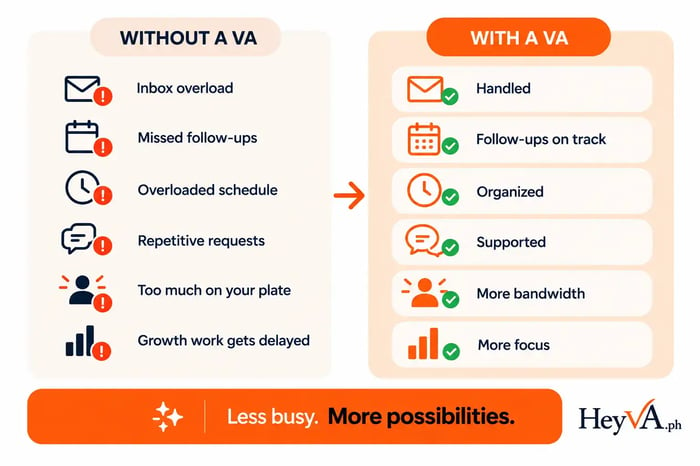
You should consider hiring a virtual assistant when recurring tasks consistently consume several hours of your week, important follow-ups are being delayed, higher-priority projects keep getting pushed back, or routine work has grown enough to justify giving someone else clear ownership.
Common signs include:
- Repetitive administrative work takes hours every week.
- Important follow-ups are regularly delayed.
- Customers or clients are waiting longer than they should.
- Higher-priority projects keep getting postponed.
- You've become the bottleneck for routine work.
- Your workload is growing faster than your available time.
- You can identify recurring responsibilities someone else could reasonably own.
One unusually busy week isn't necessarily a hiring signal.
Look for a pattern.
If the same responsibilities return to your task list week after week, they're much stronger candidates for delegation.
What should you delegate to a virtual assistant?
The best tasks to delegate are usually repeatable, remote-friendly, and clear enough that you can define the expected outcome.
Use this simple test:
| If the work is... | Consider |
|---|---|
| Repetitive and documented | Delegate |
| Recurring with a clear outcome | Delegate |
| Administrative but important | Delegate |
| Easy to review without doing yourself | Delegate |
| Dependent on your judgment or authority | Keep |
| Requires sensitive judgment or strategic authority | Usually keep internally |
| Requires specialist qualifications | Hire for that expertise |
One question can quickly clarify the decision:
Does this task require my judgment, or simply my time?
If you're doing something primarily because you've always done it, examine whether ownership can move elsewhere.
That doesn't mean delegating a responsibility without context. The person taking it over still needs the right experience, access, expectations, and authority to do the job well.
When does hiring a virtual assistant not make sense?
Hiring a virtual assistant may not make sense if you don't have clearly defined responsibilities to delegate, the work requires physical presence, or the role depends heavily on strategic authority or specialist qualifications.
For example, hiring someone with the vague instruction to ‘take things off my plate’ leaves both sides guessing about priorities, ownership, and expectations.
A VA may also be the wrong solution when:
- There isn't enough recurring work to create a meaningful role.
- The work requires regular physical presence.
- You're combining several unrelated specialist positions into one job.
- The responsibilities require authority that should remain with a founder or senior employee.
- You need professional qualifications the candidate doesn't have.
- Nobody has time to provide initial context or onboarding.
Hiring a VA doesn't fix an unclear role.
If you're not sure what you would delegate, track your workload before you start recruiting. Look for recurring work, delays, and responsibilities that don't require your direct involvement.
Do you need a virtual assistant or another type of hire?
A virtual assistant is usually worth considering when the work can be performed remotely and the responsibilities can be clearly defined.
Another type of hire may make more sense when the position requires physical presence, specialist qualifications, substantial decision-making authority, or broader ownership across the business.
| Consider a VA when... | Consider another type of hire when... |
|---|---|
| Work can be completed remotely | Physical presence is important |
| Responsibilities can be clearly defined | The role has broad organizational ownership |
| You need administrative or operational support | You need substantial strategic authority |
| Support needs can be grouped into a clear role | Responsibilities require a dedicated specialist |
| Remote collaboration fits the work | On-site collaboration is central to the position |
The job title should come after the responsibilities.
Define what needs to be owned first, then decide what type of person fits the work.
Why hire a Filipino virtual assistant?
Businesses may choose to hire a Filipino virtual assistant when they want remote support from the Philippines for areas such as administration, customer service, executive assistance, bookkeeping, marketing, or operations.
Choosing a country can narrow your candidate search, but it shouldn't replace individual evaluation.
Assess candidates based on their relevant experience, communication, role-specific skills, availability, reliability, and working style.
A candidate's location tells you where they're based. It doesn't tell you whether they're the right person for the role.
If you've already decided to recruit from the Philippines, you can explore Filipino virtual assistants on HeyVA.
Why hire a virtual Executive Assistant instead?
A virtual Executive Assistant may be a better fit when the role requires more judgment and ownership around an executive's priorities, such as calendar management, inbox prioritization, meeting preparation, travel coordination, stakeholder communication, or handling confidential information.
If you're unsure which level of support you need, our Virtual Assistant vs Executive Assistant guide can help you compare the two roles.
What is the business case for hiring a virtual assistant?
The business case starts with how much time suitable work currently consumes and what happens when that time is reassigned.
A simple example:
2 hours of repeatable work per day × 5 days = 10 hours per week
Across an average month, that's roughly 43 hours spent on work that may be suitable for delegation.
Whether hiring makes sense depends on what those responsibilities are, what it costs to delegate them, and how effectively you can use the capacity you recover.
A simple framework can help.
The HeyVA delegation test
1. How much time does the work consume?
Track recurring responsibilities during a normal week.
Don't estimate based on your busiest day. Look for work that appears consistently.
2. Does the work require you?
Separate responsibilities requiring your judgment, relationships, expertise, or authority from tasks that primarily require your time and attention.
3. What would you do with the recovered capacity?
Be specific.
Would those hours go toward sales, clients, hiring, partnerships, product work, team management, or another responsibility that's currently being delayed?
If the work is recurring, can be clearly delegated, and is preventing more important work from moving forward, you have a stronger business case for hiring.
This doesn't mean every delegated hour generates revenue. Hiring a VA also requires time for selection, onboarding, communication, and management.
The decision is better framed as a comparison between the cost of delegating suitable work and the value of the capacity you recover.
For the budgeting side of that decision, see our guide to how much it costs to hire a virtual assistant.
How HeyVA helps you hire a virtual assistant
Once you've decided that hiring a VA makes sense, the next step is turning the responsibilities you've identified into a clear role.
HeyVA helps businesses hire remote talent from the Philippines while keeping the employer in control of the final decision.
Define the role
Tell Alexandra, HeyVA's AI hiring manager, what you need help with, what the person should own, and what matters for the position.
Screen against your requirements
Alexandra can help review applicants against your criteria and follow up with candidates about relevant experience, skills, and availability.
Review candidates
You decide which candidates you want to meet.
Interview and hire
Alexandra can help coordinate interviews. You decide who joins your team.
If you're ready to move from deciding why to figuring out how, our guide on how to hire a virtual assistant covers the hiring process in more detail.
Decide based on where your time is going
Look at where your time went last week.
If several hours were spent on recurring work that someone else could learn and own, you may already have the foundation of a useful virtual assistant role.
Start with those responsibilities. Define the outcomes, decide what should remain with you, and hire for the experience needed to take ownership of the rest.
For businesses ready to hire remote talent from the Philippines, HeyVA can help with the work between defining the role and meeting candidates while leaving the final hiring decision with you.
FAQs
Why should I hire a virtual assistant?
You should consider hiring a virtual assistant when recurring work is taking time away from responsibilities that require your expertise, relationships, or authority. A VA can take ownership of suitable administrative, operational, or support work so those responsibilities no longer depend on you to move forward.
Why would a business hire a virtual assistant?
Businesses hire virtual assistants when they need additional capacity for clearly defined work that can be performed remotely. Common use cases include administrative support, scheduling, customer communication, research, reporting, CRM management, and other recurring responsibilities.
When should I hire a virtual assistant?
Consider hiring a VA when the same tasks consume several hours every week, important work is regularly delayed, or you've become the bottleneck for repeatable processes. A recurring workload is a stronger hiring signal than one unusually busy period.
What tasks should I give a virtual assistant?
Virtual assistants can handle responsibilities such as inbox administration, scheduling, research, CRM updates, customer follow-ups, reporting, documentation, and other recurring support work. Choose tasks with clear outcomes and match them to the candidate's actual experience.