

Table of Contents
- How to hire a virtual assistant in 8 steps
- 1. Decide what you actually need help with
- 2. Define the virtual assistant role
- 3. Decide between a part-time and full-time VA
- 4. Set a realistic budget
- 5. Choose where to find a virtual assistant
- 6. Screen for skills, role fit, and reliability
- 7. Interview your strongest candidates
- 8. Agree on expectations and onboard your VA
- How to hire a virtual assistant from the Philippines
- How HeyVA helps with the hiring process
- Ready to hire your virtual assistant?
- FAQs
Hiring a virtual assistant isn't difficult because there aren't enough candidates. The hardest part on how to hire a virtual assistant is figuring out what you need, finding people with the right experience, and knowing who you can rely on once they're working remotely.
To hire a virtual assistant, start by identifying the work you want to delegate. Then define the role, decide whether you need part-time or full-time support, set your budget, find candidates, screen for skills and reliability, interview your strongest applicants, and agree on expectations before onboarding your new VA.
Here's the process step by step.
How to hire a virtual assistant in 8 steps
Identify what you want to delegate.
Define the VA role and required skills.
Decide between part-time and full-time support.
Set a realistic hiring budget.
Choose where to find candidates.
Screen and interview your strongest applicants.
Agree on expectations before hiring.
Onboard your virtual assistant properly.
The important part on how to hire a virtual assistant isn't getting through these steps as quickly as possible. It's gathering enough information to make a good hiring decision.

1. Decide what you actually need help with
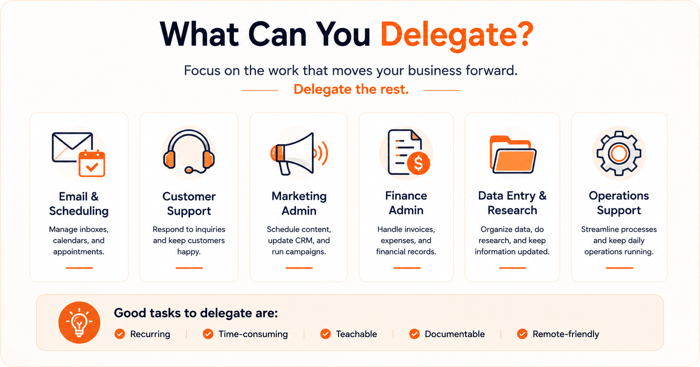
Before writing a job description, look at where your time goes.
Which tasks repeat every week? Which ones don't require your judgment? Which keeps getting pushed aside because something more important comes up?
Those are often good places to start.
If you're spending time on... | You could delegate... |
Email and scheduling | Inbox organization, calendar management, appointment scheduling |
Customer administration | Inbox monitoring, ticket updates, follow-ups |
Marketing administration | Content scheduling, CRM updates, basic reporting |
Finance administration | Invoice preparation, expense organization, data entry |
Day-to-day operations | Research, spreadsheets, documentation, database updates |
The best tasks to delegate tend to be recurring, time-consuming, teachable, and easy to perform remotely.
That doesn't mean you should immediately hand over everything you dislike doing. If a task depends heavily on founder-level judgment or you can't yet explain what a good outcome looks like, you may need to clarify the process first.
Start with work you can explain and measure. Expand the VA's responsibilities as trust and experience develop.
2. Define the virtual assistant role
A vague job description usually attracts a vague applicant pool.
‘Looking for a rockstar VA who can do everything’ doesn't tell candidates much about the job, or help you determine who is actually qualified.
Before you start looking, define:
The tasks they'll own
The outcomes you expect
Skills and previous experience required
Software they'll use
Working hours and required timezone overlap
Who they'll report to
How you'll communicate
Expected availability
Start date
Also decide what type of VA you actually need.
A virtual administrative assistant might manage calendars, documents, data, and recurring admin. A virtual marketing assistant could help with CRM updates, content scheduling, campaign administration, and reporting. A virtual personal assistant may focus more heavily on scheduling, research, bookings, and personal administration.
If the role requires bookkeeping, advanced SEO, paid media, design, or another specialist skill, say so. Don't assume a general VA will automatically have specialist expertise.
Hire for the work you need done, not the job title you think you need.
3. Decide between a part-time and full-time VA
Let your workload determine this decision.
If you have 10–15 hours of clearly delegable work each week, hiring someone full-time simply because you eventually hope to fill their schedule can create unnecessary cost and unclear expectations.
Part-time VA | Full-time VA | |
Best for | Limited or variable workload | Consistent recurring workload |
Availability | May work with other clients | Greater dedicated availability |
Work volume | Several hours per day or week | Ongoing daily responsibilities |
Good starting point | Clearly defined tasks | Established processes and larger workload |
You can track recurring tasks for a week or two and estimate how long they take. That gives you a more realistic picture of the support you actually need.
You can always increase someone's hours as the role develops.
4. Set a realistic budget
How much it costs to hire a virtual assistant depends on location, experience, specialization, responsibilities, and the hiring model you choose.
As a broad market reference, Wise currently places entry-level VA rates around $5–$15 per hour, mid-level support around $15–$30 per hour, and specialist work around $30–$75+ per hour. These are broad international ranges rather than fixed rates for Filipino VAs.
Current candidates visible on HeyVA also illustrate why a single VA rate can be misleading: listed rates vary based on the person's experience and skill set.
Don't automatically hire the cheapest applicant.
If someone needs constant correction, misses deadlines, or can't perform the work independently, a low hourly rate can become expensive quickly.
Set a range you can sustain, then evaluate candidates based on whether their experience matches the responsibilities you're delegating.
5. Choose where to find a virtual assistant
There isn't one right place to hire a virtual assistant. The better option depends on how much of the recruiting, screening, and management you want to handle yourself.
Hiring option | Best for | What to consider |
Freelance marketplace | Projects and flexible support | You typically handle more screening and management |
Job board/direct hiring | Employers comfortable recruiting themselves | More control, but more hiring work |
Businesses wanting additional managed support | Understand fees, candidate choice, and management model | |
Remote hiring platform | Businesses wanting hiring tools and access to remote talent | Screening and support vary by platform |
When comparing options, don't look only at the advertised hourly rate.
Ask:
Who screens the applicants? Who chooses the candidate? Are there ongoing salary markups? Who handles payroll? What happens if the hire doesn't work out? What support continues after hiring?
These differences can matter as much as the initial cost.
If you're specifically looking to hire a Filipino virtual assistant, HeyVA provides access to verified candidates and uses Alexandra, its AI hiring manager, to assist with role creation, screening, follow-up questions, and interview scheduling. You still choose who to interview and hire.
Prefer to watch? See how to hire a virtual assistant hiring works and what to consider before choosing the right person for your business.
6. Screen for skills, role fit, and reliability
A good résumé tells you what someone says they've done.
Screening should help you determine whether they can do what you need.
Start with relevant experience. Instead of asking:
Have you managed a CRM before?
Ask which CRM they used, what they were responsible for, how often they used it, and what a normal workflow looked like.
Specific answers are much more useful than yes/no claims.
Check role-specific skills
If spreadsheet work is central to the role, assess spreadsheet ability. If the VA will respond to customers, evaluate written communication. If they'll manage your calendar, ask how they've handled competing priorities.
A short, relevant skills assessment can tell you more than another 30 minutes discussing someone's résumé.
Review work samples where appropriate
Ask for examples related to the actual responsibilities.
The goal isn't to make candidates prove every skill they claim. It's to gather enough evidence to make a sensible decision.
Pay attention to the hiring process itself
The application process gives you early information about how someone works.
Did they follow instructions? Were their answers specific? Did they communicate clearly? Did they show up when expected?
These aren't guarantees of future performance, but they're useful signals.
Look for evidence of reliability
Reliable is easy to put on a résumé.
It's harder to demonstrate.
Ask candidates to describe a time when they realized they might miss a deadline. What did they do? When did they tell the person they were working with? How did they resolve it?
You're not necessarily looking for someone who has never made a mistake.
You're looking for evidence of ownership, communication, and judgment when something goes wrong.
7. Interview your strongest candidates
You don't need to interview everyone who meets the basic requirements.
Use screening to narrow the pool, then spend your interview time understanding how your strongest candidates think and work.
Virtual assistant interview questions to ask
Walk me through a recurring task you owned in your last role.
Tell me about a time you received unclear instructions. What did you do?
How do you prioritize when several tasks are urgent?
Tell me about a mistake you made at work. How did you handle it?
Which tools have you used regularly rather than occasionally?
What do you do if you realize you're going to miss a deadline?
How do you prefer to receive feedback?
What working hours can you consistently commit to?
Can you show or describe work similar to what this role requires?
What questions do you have about the role?
Listen for specific examples like;
We communicated well as a team, it tells you very little.
Another is: I sent my manager a daily update in Slack, flagged anything blocking me, and documented completed tasks in ClickUp’ tells you considerably more.
Watch for red flags
Potential warning signs include:
Vague answers about previous responsibilities
Experience that doesn't match the examples provided
Repeatedly ignoring application instructions
Poor or inconsistent communication
Unexplained availability conflicts
Claiming advanced expertise across an unrealistic number of unrelated areas
Refusing reasonable skills verification
Consistently blaming previous clients or employers for problems
Don't reject someone because of one imperfect answer. Look for patterns across their application, screening, interview, references, and work samples.
8. Agree on expectations and onboard your VA
Hiring isn't finished when someone accepts the role.
Before they start, make sure you're both clear on:
Responsibilities
Working hours
Compensation and payment schedule
Communication channels
Expected response times
Time-off arrangements
Confidentiality and data access
How work will be reviewed
How often you'll check in
Then give them enough context to succeed.
During the first week, introduce the business and relevant team members, explain what success looks like, provide secure access to the tools they need, and share SOPs or examples for recurring work.
Start with clearly defined tasks rather than handing over your entire operation on day one.
Give feedback early. If something isn't being done the way you expected, explain what needs to change and why.
A good VA can take ownership, but they still need context.
How to hire a virtual assistant from the Philippines
The core hiring process doesn't change when you hire a virtual assistant from the Philippines: define the role, screen for the required skills, interview for evidence of reliability and fit, and set expectations before hiring.
There are, however, a few practical details to clarify.
Discuss required timezone overlap rather than assuming candidates will work your local hours. Be explicit about communication requirements, compensation, payment method, holidays, and the working arrangement you're offering.
Most importantly, don't lower your hiring standards because you're recruiting offshore.
Evaluate a Filipino virtual assistant based on whether they can perform the work your business needs, communicate effectively, and take responsibility for the role.
If you're ready to move from researching to interviewing, you can find and hire Filipino virtual assistants with HeyVA. Candidate profiles on HeyVA are verified, and the platform currently shows professionals across administrative support, customer service, executive assistance, operations, and other specialties.
How HeyVA helps with the hiring process
You can handle every stage in this guide yourself.
But if manually screening applications and coordinating interviews is exactly the kind of work you're trying to get off your plate, HeyVA can reduce some of that recruiting workload.
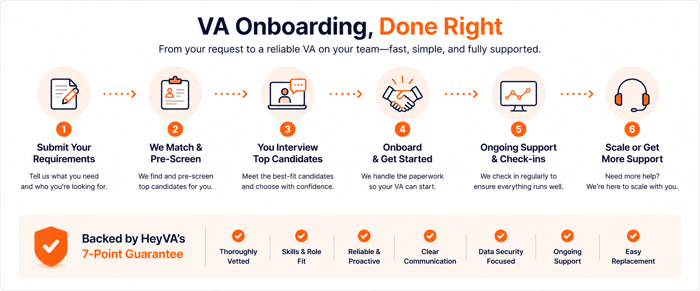
The process works like this:
1. Describe the role.
Tell Alexandra who you’re looking for, what needs to be done, including responsibilities, experience, skills, working hours, and other requirements.
2. Screen candidates.
Alexandra helps evaluate applicants against the criteria you've set and can follow up about experience, skills, and availability.
3. Review your stronger matches.
Use the screening information to decide who you want to meet.
4. Schedule interviews.
Alexandra can help coordinate interviews with your calendar.
5. Interview and decide.
You meet the candidates and make the final hiring decision.
Alexandra helps with the repetitive recruitment work. You decide who gets hired.
Ready to hire your virtual assistant?
A successful VA hire starts before you post the job.
Know what you want to delegate. Define the role clearly. Screen for evidence, not promises. Ask better interview questions. Then give the person you hire the context and expectations they need to succeed.
If you've done that work and you're ready to meet candidates, HeyVA can help with the next step.\

FAQs
How do I hire a good virtual assistant?
Start with a clearly defined role, then screen candidates for relevant experience, role-specific skills, communication, availability, and evidence of reliability. Use interviews to ask for specific examples of previous work rather than relying only on a résumé or the candidate's hourly rate.
How much does it cost to hire a virtual assistant?
VA rates vary by experience, location, specialization, and hiring model. Broad international market estimates range from around $5–$15 per hour for entry-level VAs to $30–$75+ for specialist support, although actual rates can fall outside these ranges.
Where can I hire a virtual assistant online?
You can hire through freelance marketplaces, job boards, VA agencies, or remote hiring platforms. The right option depends on how much recruiting, screening, management, and administrative work you want to handle yourself.
How do I know whether a virtual assistant is reliable?
Look for evidence rather than self-described traits. Ask how candidates have handled deadlines, mistakes, competing priorities, and unclear instructions. Their communication, punctuality, ability to follow instructions, references, and relevant work history can also provide useful signals.
Should I give a virtual assistant a skills test?
A short skills assessment can be useful when it reflects work the person will actually perform. Keep it relevant and proportionate. If you're hiring someone to manage spreadsheets, for example, a brief spreadsheet task will usually tell you more than a generic aptitude test.
Is it better to hire a freelance VA or use an agency?
Neither is automatically better. Freelance hiring can provide more flexibility and direct control but generally requires more recruiting and management from you. Agencies may provide additional screening or management support but can have different pricing structures and levels of employer control.