

Table of Contents
- Virtual assistant benefits at a glance
- 1. Get time back from recurring work
- 2. Reduce operating overhead
- 3. Add capacity without immediately adding local headcount
- 4. Spend more time on higher-value work
- 5. Scale support more flexibly
- 6. Access skills you don't have internally
- 7. Keep recurring work moving consistently
- 8. Create more capacity for growth
- The 4-question delegation test
- Is hiring a virtual assistant actually cost-effective?
- When does hiring a virtual assistant make sense?
- What are the disadvantages of hiring a virtual assistant?
- When might a VA not be the right solution?
- Virtual assistant vs employee: which makes more sense?
- The benefits of a virtual assistant depend on who you hire
- What about hiring a virtual assistant from the Philippines?
- How to decide whether hiring a VA is worth it
- How HeyVA can help when you're ready to delegate
- Get your time back without lowering your hiring standards
- FAQs
Your inbox needs organizing. Meetings need scheduling. The CRM needs updating. Reports need preparing. Customers need following up with. One of the biggest benefits of a virtual assistant is having someone take ownership of this recurring work, so you can spend more time on the parts of the business that actually require you.
None of these tasks may take much time on their own. Together, they can consume hours every week.
That's where a virtual assistant can help.
The main benefits of a virtual assistant are getting time back, reducing operating overhead, increasing capacity, improving focus, adding flexibility, accessing specialized skills, keeping recurring work moving, and creating more room for growth.
But there's an important condition behind every one of those benefits: delegation only works when you give the right work to someone capable of owning it.
Virtual assistant benefits at a glance
Benefit | What it can mean for your business |
More time | Delegate recurring work that doesn't require your direct involvement |
Lower overhead | Add remote capacity without necessarily expanding your office-based team |
More capacity | Give important recurring work a clear owner |
Better focus | Spend more time on customers, strategy, sales and leadership |
More flexibility | Match support more closely to your workload |
Access to skills | Hire remote professionals with relevant experience |
Greater consistency | Keep routine processes from continually falling behind |
Room to grow | Redirect reclaimed capacity toward higher-value work |
Here's what the benefits of a virtual assistant look like in practice.

1. Get time back from recurring work
For many founders, this is the biggest benefit of having a virtual assistant.
Look at the recurring tasks that quietly fill your week:
Calendar management
Inbox organization
Data entry
CRM updates
Routine reporting
Research
Customer follow-ups
Content scheduling
Document organization
Individually, these tasks might take 10 or 20 minutes. The problem is how quickly they add up.
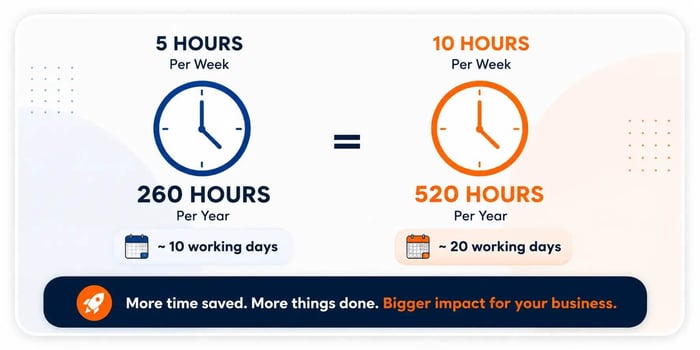
If delegating recurring work saves you five hours each week, that's:
5 hours × 52 weeks = 260 hours per year
That's roughly 32 eight-hour working days.
If you successfully delegate 10 hours each week:
10 hours × 52 weeks = 520 hours per year
That's roughly 65 working days.
But getting 520 hours back doesn't automatically make your business more productive.
The real question is:
What will you do with those hours instead?
If you redirect them toward sales, client relationships, product development, strategy, leadership, or other work that requires your judgment, delegation can become much more valuable.
If you spend those same hours micromanaging your VA, you've gained very little.
2. Reduce operating overhead
Cost is another reason businesses consider using a virtual assistant.
A remote VA generally doesn't require additional physical office space, and hiring remotely can open your search beyond your immediate local labor market.
That matters because the cost of an employee isn't limited to salary.
For context, U.S. Bureau of Labor Statistics data for March 2026 shows that wages and salaries accounted for 69.9% of total private-industry employee compensation, while benefits represented another 30.1%. For office and administrative support occupations specifically, benefits represented 31.3% of total employer compensation.
But that doesn't mean hiring a VA automatically saves 30%. Employment arrangements differ, as do taxes, benefits, legal obligations and contractor requirements.
The more useful question is:
What is the total cost of getting this work done well?
A $6-per-hour VA who requires constant supervision isn't necessarily better value than a $10-per-hour VA who can take ownership after onboarding.
Look beyond the hourly rate.
3. Add capacity without immediately adding local headcount
Sometimes your business doesn't need another manager.
It just needs another capable person to own a defined set of responsibilities.
Imagine an operations manager spending several hours every week updating records, preparing routine reports, organizing documentation and following up on administrative requests.
That work still matters.
But it may not require a manager to do it.
A capable virtual assistant can take ownership of clearly defined operational work so other people on the team have more room for responsibilities that require their experience.
That's one of the practical benefits of a virtual assistant: you can move work to the appropriate level of ownership instead of continually giving it to whoever happens to have time.
4. Spend more time on higher-value work
Saving time and improving focus are related, but they're not the same thing.
Saving time means doing fewer tasks yourself.
Improving focus means using the time you recover more deliberately.
A founder might delegate:
Calendar administration
Inbox organization
CRM updates
Research
Routine reporting
Meeting coordination
while continuing to own:
Business strategy
Important sales conversations
Partnerships
Leadership
Key customer relationships
Major hiring decisions
A useful question for any task is:
Does this require my knowledge, authority or judgment?
If it doesn't, then someone else can be trained to own it. It may be a good candidate for delegation.
The goal isn't to get rid of every task you dislike. It's to protect more of your time for work where your involvement actually matters.
5. Scale support more flexibly
Not every business needs another full-time person immediately.
Perhaps you have 10 hours of delegable work each week today. As the business grows, that could become 20 hours and eventually a full-time workload.
Depending on the working arrangement, a VA can give businesses room to increase support as their workload becomes more predictable.
For example:
10 hours/week → 20 hours/week → full-time
That can be useful for a small business that clearly needs help but doesn't yet have enough recurring work for a full-time role.
Don't assume flexibility, though.
A part-time VA may support other clients. Before hiring, discuss availability, working hours, timezone overlap and whether additional hours could be available later.
6. Access skills you don't have internally
Virtual assistant is a broad term.
Some VAs focus on general administrative support. Others have experience in specific business functions.
Depending on the person you hire, remote support can include:
Executive assistance
Marketing operations
Bookkeeping
E-commerce support
Research
This can help businesses access skills they don't currently have in-house without assuming every responsibility needs a separate local hire.
But avoid looking for a mythical VA who can do everything.
If your main problem is bookkeeping, look for bookkeeping experience. If you need technical SEO, hire someone with technical SEO expertise. If you need complex executive support, an experienced Executive Assistant may be a better fit than a general VA.
Hire for the work, not the title.
7. Keep recurring work moving consistently
Some work doesn't fall behind because it's difficult.
It falls behind because nobody clearly owns it.
Think about:
CRM maintenance
Weekly reports
Customer follow-ups
Inbox organization
Documentation
Database updates
Content scheduling
Routine research
These tasks are easy to postpone when something more urgent comes up.
Tomorrow becomes next week. Next week becomes the end of the month.
Giving recurring work to a capable VA creates ownership.
Delegation isn't only about doing less yourself. It's about making sure important recurring work actually gets done.
That consistency can improve day-to-day business operations even when the individual tasks seem relatively small.
8. Create more capacity for growth
A virtual assistant won't automatically grow your business.
But what a VA can do is create capacity that you can choose to use for growth.
Consider a founder whose week looks something like this:
Work | Hours per week |
Administration | 10 |
Scheduling and routine follow-ups | 5 |
Sales, client work and leadership | 25 |
If 10 hours of administrative work can be delegated successfully, the founder now has choices.
Those hours could go toward:
Speaking with prospective customers
Improving client delivery
Developing a product
Building partnerships
Recruiting and managing the team
Strategic planning
Or they could simply make an unsustainable workload more manageable.
Both outcomes have value.
The important distinction is that a VA creates capacity, not guaranteed revenue. What you do with that additional capacity determines the business impact.
The 4-question delegation test
Before deciding you need a virtual assistant, take one task from your workload and ask:
1. Does this task need to be done regularly?
2. Does it require me personally?
3. Can I explain what a good result looks like?
4. Can someone perform it remotely?
A task that produces:
Yes → No → Yes → Yes
is usually a stronger candidate for delegation.
For example, your weekly CRM cleanup needs to happen regularly, probably doesn't require the founder, has a clear desired outcome, and can be performed remotely.
Negotiating the sale of your company? Probably not one to hand over.
Apply the test across your workload. If you identify several hours of recurring work that fits the pattern, you have a much stronger reason to consider hiring.
Is hiring a virtual assistant actually cost-effective?
A virtual assistant can be cost-effective when the value of the work you reclaim exceeds the cost and management required to delegate it.
A simple way to think about it is:
Value of time reclaimed − VA cost − management overhead = potential delegation value
Here's a hypothetical example.
Suppose you estimate that an hour of your productive time is worth $75 to the business and you're spending eight hours every week on work that could reasonably be delegated.
8 hours × $75 = $600 of founder time each week
That does not mean hiring a VA will generate an extra $600 in revenue.
It means you now have a useful comparison:
Is paying someone else to handle those eight hours a better use of resources than continuing to handle them yourself?
You also need to account for onboarding and management. A new VA needs context, training, feedback and communication.
The goal is for that management requirement to decrease as the person learns the role and takes greater ownership.
When does hiring a virtual assistant make sense?
Hiring a virtual assistant makes sense when you have recurring, remote-friendly work that doesn't require your direct involvement and enough of it to justify delegation. A VA can be particularly useful when administrative or operational tasks are taking time away from customers, sales, strategy or other higher-value responsibilities.
You may be ready when:
You're repeatedly doing work someone else could be trained to handle
Administrative tasks are taking time away from higher-value responsibilities
Important recurring processes keep falling behind
You need additional capacity but don't need another senior hire
You can clearly explain the work and expected outcome
The responsibilities can be performed remotely
You have enough recurring work to make delegation worthwhile
Being busy isn't enough.
The stronger signal is being able to point to a meaningful part of your workload and say:
‘I don't need to be the person doing this every week.’
What are the disadvantages of hiring a virtual assistant?
Virtual assistants also come with trade-offs. Potential disadvantages include onboarding time, communication gaps, timezone differences, management overhead, security and account-access considerations, and the risk of hiring someone whose skills don't match the role.
Those aren't necessarily reasons not to hire.
They're things you need to plan for.
For example, timezone differences matter far less for asynchronous research than they do for someone answering live customer calls. Security concerns can be reduced with appropriate permissions, password-management tools and clear access policies.
The bigger problem is often poor role definition.
If you can't explain what you want someone to own, hiring another person can simply add another layer of communication to an already messy process.
When might a VA not be the right solution?
A virtual assistant may not be the right choice when:
You can't identify what you want to delegate
Most responsibilities still require your personal judgment
There isn't enough recurring work
You expect one person to cover several unrelated specialist roles
You can't provide any onboarding or context
The role requires regular physical presence
You're trying to solve a broken process simply by adding another person
Sometimes the first step isn't hiring.
It's fixing the process.
Don't hire a VA simply because you're overwhelmed. Hire when you can identify work another capable person can realistically own.
Virtual assistant vs employee: which makes more sense?
A virtual assistant isn't automatically a better choice than an employee.
They're different ways of solving a staffing problem.
Virtual assistant | Employee | |
Typical location | Remote | Remote, hybrid or onsite |
Best suited to | Clearly defined remote responsibilities | Roles requiring deeper organizational or onsite integration |
Hours | Can vary by arrangement | Usually more structured |
Physical office required | Usually no | Depends on the role |
Flexibility | Can be higher depending on arrangement | Usually more structured |
Management required | Yes | Yes |
Good fit when | Work is transferable and remote-friendly | Role requires employee relationship, physical presence or deeper integration |
The right choice depends on the role, workload, working arrangement, legal requirements and level of integration your business needs.
There can also be meaningful differences in total compensation costs. That doesn't make a VA inherently cheaper or better. It simply means you should compare the total arrangement, not one hourly number.
The benefits of a virtual assistant depend on who you hire
There's a condition behind almost every benefit in this article.
A VA doesn't save time if you're constantly redoing their work.
A lower hourly rate doesn't reduce costs if poor performance means you need to hire again three months later.
Delegation doesn't improve your focus if you're continually checking whether every task was completed.
And flexible remote support isn't useful if someone's availability doesn't match what your business needs.
That's why candidate quality and role fit matter.
When evaluating a virtual assistant, look for:
Relevant experience
Role-specific skills
Clear communication
Reliability
Suitable availability
Ability to follow processes
Evidence of previous work
Ownership and accountability
You don't need someone who claims to be good at everything.
You need someone capable of owning the work you're trying to delegate.
If you've reached this point, the next step is learning how to hire a virtual assistant, including how to define the role, screen applicants, assess reliability and interview your strongest candidates.
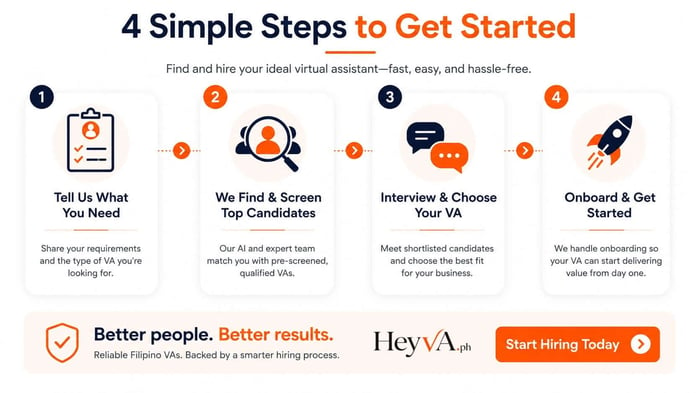
Want to see the hiring process in action? Watch this quick video for a practical look at finding and hiring the right virtual assistant for your business.
What about hiring a virtual assistant from the Philippines?
Some business cases don't change when you hire internationally: the work still needs to be suitable for delegation, and the person still needs the right skills and reliability.
For businesses considering Filipino remote talent, the opportunity extends well beyond general administration. HeyVA's partners commonly hire for Executive Assistant roles, customer support, social media, bookkeeping and increasingly AI-capable remote roles.
Location shouldn't replace proper hiring criteria, though.
Don't hire someone simply because they're in the Philippines or because their rate is lower than your local market.
Hire them because their experience, communication, availability and skills fit the role.
How to decide whether hiring a VA is worth it
If you're still unsure, answer these four questions.
1. What would you delegate?
Write down the recurring work you want someone else to own.
If you can identify five or 10 hours of suitable work each week, you have something concrete to evaluate.
2. What is that work costing you now?
Don't look only at the number of hours.
Consider what you're not doing because those tasks are consuming your time.
3. Can someone else realistically own it?
The strongest tasks for delegation tend to be repeatable, teachable, documentable and remote-friendly.
If the work depends almost entirely on your judgment, it may not be ready to hand over.
4. What will you do with the time you get back?
This may be the most important question.
If getting 10 hours back means spending 10 hours micromanaging someone, you've gained very little.
If those hours let you sell, lead, build, serve customers, or simply run the business at a more sustainable pace, the case for delegation becomes much stronger.
How HeyVA can help when you're ready to delegate
The benefits of a virtual assistant depends on finding someone capable of actually owning the work.
That's often the difficult part.
HeyVA helps businesses find and screen Filipino remote professionals based on the role they're trying to fill. Alexandra, HeyVA's AI hiring manager, helps with repetitive recruitment work such as defining the role, screening applicants and coordinating interviews. The commercial hiring process is designed to reduce manual screening while keeping the employer in control of the final decision.
You decide who you interview and who you hire.
If you've identified recurring work you're ready to delegate, the next step is finding someone capable of owning it.
Get your time back without lowering your hiring standards
The real benefit of a virtual assistant isn't simply having another person on your team.
It's having the right work owned by the right person, so you don't remain the default person for every recurring task in the business.
Then hire for the skills and reliability required to own the work.
When you're ready, HeyVA can help you find and screen Filipino virtual assistants for your business.
FAQs
What are the main benefits of a virtual assistant?
The main benefits of a virtual assistant include saving time, reducing operating overhead, adding capacity, improving focus, increasing flexibility, accessing specialized skills, keeping recurring work moving, and creating more room for growth. The actual value depends on hiring the right person and delegating work they can realistically own.
Is hiring a virtual assistant worth it?
Hiring a virtual assistant can be worth it when you have enough recurring, transferable work to delegate and can put the reclaimed time to better use. Compare the cost of the VA and required management against the value of the time and capacity you expect to recover.
How can a virtual assistant save a business money?
A remote VA may help a business avoid some costs associated with expanding an office-based team and allow work to be handled at an appropriate skill level. However, actual savings depend on the working arrangement, candidate productivity and role fit, not simply finding the lowest hourly rate.
How much time can a virtual assistant save?
It depends on what you successfully delegate. Saving five hours per week equals approximately 260 hours per year, while 10 hours per week equals around 520 hours per year. Actual savings depend on the workload and how independently the VA can handle it.
What tasks should I delegate to a virtual assistant?
Start with tasks that are recurring, teachable, documentable and remote-friendly and don't require your personal involvement every time. Examples include calendar administration, inbox organization, CRM updates, data entry, routine reporting, research, scheduling and customer follow-ups.
What are the disadvantages of hiring a virtual assistant?
Potential disadvantages include onboarding time, communication challenges, timezone differences, management overhead, data-access considerations and poor role fit. Many of these risks can be reduced through clear responsibilities, appropriate screening, secure systems and realistic onboarding.
Is a virtual assistant better than hiring an employee?
Neither is universally better. A VA can work well for clearly defined remote responsibilities and businesses that want additional capacity without necessarily adding an office-based role. An employee may be more suitable when the position requires physical presence, deeper organizational integration or a specific employment arrangement.
What should I look for when hiring a virtual assistant?
Look for relevant experience, role-specific skills, clear communication, reliability, appropriate availability and evidence that the person can take ownership of the responsibilities you're delegating. Evaluate candidates against the actual role rather than choosing primarily on price.