

Table of Contents
- Do you actually need a virtual assistant?
- When should you hire a virtual assistant?
- 8 signs it's time to hire a virtual assistant
- 1. Repetitive tasks are taking over your week
- 2. You've become the administrative bottleneck
- 3. Higher-value work keeps getting postponed
- 4. Your client or customer workload is growing
- 5. You need more capacity but aren't ready for another local hire
- 6. Important recurring tasks keep falling behind
- 7. You need coverage across more of the working day
- 8. You've identified work someone else could genuinely own
- What kind of virtual assistant support do you actually need?
- Should I hire a virtual assistant? Use this 5-question test
- When you probably shouldn't hire a virtual assistant yet
- Pros and cons of hiring a virtual assistant
- What should you delegate first?
- How can virtual assistants improve a business?
- Ready to delegate? Here's what comes next
- Stop asking how to do more. Ask what you shouldn't be doing anymore.
- FAQs
Being busy isn't automatically the best reasons to hire a virtual assistant.
The stronger signal is when recurring work starts taking time away from responsibilities that actually require you.
Your inbox needs attention. Meetings need scheduling. Customer records need updating. Reports need preparing. Follow-ups keep piling up. None of these tasks are necessarily difficult, but together they can consume a surprising amount of your week.
The best reasons to hire a virtual assistant usually come down to capacity, ownership, and focus. You have recurring work that can be done remotely, it doesn't require your direct involvement every time, and keeping it on your plate is starting to slow down more important work.
In short: you should consider hiring a virtual assistant when repetitive work is consuming too much of your time, administrative tasks are becoming a bottleneck, important work keeps getting postponed, customer workload is growing, or you need additional capacity without immediately adding another local role.
The important part is knowing whether you've actually reached that point.
Do you actually need a virtual assistant?
A packed calendar alone doesn't mean you need to hire one.
Look for a recurring pattern instead.
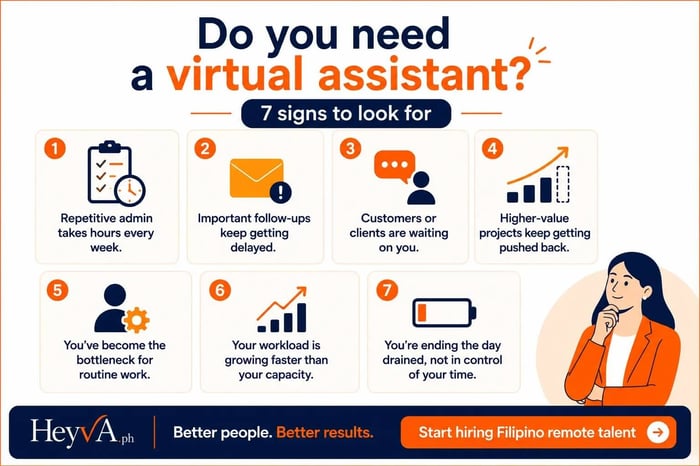
You may be ready for a virtual assistant if several of these are happening regularly:
You spend hours every week on repeatable administrative work.
Important follow-ups get delayed because you're too busy.
Customers or clients are waiting longer than they should.
Higher-value projects keep moving to next week.
You're the person everyone waits on for routine processes.
Your workload is growing, but much of the additional work can be done remotely.
You can already identify recurring responsibilities someone else could own.
One bad week isn't necessarily a hiring problem.
But if you've been saying, ‘I'll get to that when things calm down’ for the last three months, the problem may no longer be your to-do list. You may simply have more work than you should personally be doing.
When should you hire a virtual assistant?
You should hire a virtual assistant when recurring, remote-friendly work is consistently taking time away from responsibilities that require your expertise. Common signs include spending hours on administrative tasks, delaying higher-value work, falling behind on routine processes, growing customer workload, or needing additional capacity.
The key words are recurring and remote-friendly.
If a task happens once a year, hiring ongoing support probably isn't the answer. If the work requires you to be physically present, a remote professional isn't going to solve it either.
But when the same work appears weeks after week and can be clearly delegated, hiring becomes much easier to justify.
Here are eight signs worth paying attention to.

8 signs it's time to hire a virtual assistant
For most growing businesses, the best reasons to hire a virtual assistant become clear when routine work starts competing with higher-value priorities.
1. Repetitive tasks are taking over your week
Start by looking at the work you repeat.
How much time goes into:
Organizing email
Scheduling meetings
Updating spreadsheets
Entering CRM data
Preparing routine reports
Researching information
Organizing documents
Following up with customers or leads
Each task might only take 15 or 30 minutes.
The problem is accumulation.
A founder might spend an hour every morning working through email, updating records, moving meetings around, and chasing information before getting anywhere near sales, customers, strategy, or team management.
That's one of the clearest reasons to hire a virtual assistant.
2. You've become the administrative bottleneck
Sometimes the problem isn't how much work exists.
It's that everything has to pass through one person.
Maybe that's you.
Meetings don't get scheduled until you respond. Documents aren't sent until you prepare them. CRM records stay outdated. Follow-ups wait. Someone needs information, and you're the only person who knows where it is.
Eventually, the business starts moving at the speed of your availability.
That doesn't necessarily mean you need another manager or senior employee.
You may simply need someone who can take ownership of recurring administrative work.
For example, a VA could coordinate meetings, prepare routine documents, maintain internal records, organize files, manage follow-ups, and keep administrative processes moving without waiting for you to initiate every step.
A bottleneck isn't always a people problem. Sometimes it's an ownership problem.
3. Higher-value work keeps getting postponed
Most business owners can identify the projects they should be spending more time on.
Talking to important customers.
Improving sales.
Developing partnerships.
Hiring.
Reviewing performance.
Building better processes.
Planning what comes next.
Yet those projects are remarkably easy to postpone when the inbox is full and there are 12 smaller things demanding attention.
Consider a simple example.
If you spend eight hours per week on work that could reasonably be delegated:
8 hours × 52 weeks = 416 hours per year.
That's equivalent to roughly 52 eight-hour working days.
Hiring a virtual assistant doesn't magically turn all 416 hours into productive growth. You'll still need to communicate, delegate, review work, and manage the person you hire.
But the calculation highlights the real opportunity cost.
If hundreds of hours each year are going into tasks that don't require your expertise, ask what else some of that time could be used for.
Delegation becomes valuable when it creates room for work only you can do.
4. Your client or customer workload is growing
Growth creates work.
A new client doesn't only create revenue. They can also create:
More emails
More meetings
More reports
More CRM updates
More documents
More follow-ups
More scheduling
More customer questions
Add enough customers without adding operational capacity and the business can become harder to run even while revenue is moving in the right direction.
This is particularly common in service businesses and agencies.
An agency founder might add three new accounts, for example, but continue personally coordinating meetings, preparing routine reports, updating project records, and chasing information from clients.
Eventually, that workload starts competing with the work required to retain existing clients and win new ones.
A VA can provide additional remote support by taking ownership of clearly defined administrative or coordination responsibilities as the business grows.
5. You need more capacity but aren't ready for another local hire
Not every growing workload requires another employee sitting nearby.
Ask what the job actually involves.
If the responsibilities are primarily performed through email, a browser, your CRM, project management software, video meetings, or cloud-based systems, geographic proximity may add little value to the role.
That doesn't automatically mean hiring a virtual assistant is the right decision.
You should still consider:
Responsibilities
Required experience
Working hours
Communication requirements
Management needs
Expected workload
Total hiring cost
But if the work is genuinely remote-friendly, limiting the candidate pool to people within commuting distance may be unnecessary.
This is one reason businesses consider remote professionals when they need additional capacity without building every new role around a traditional local-office model.
The goal shouldn't be to find the cheapest person available.
The goal is to find someone capable of owning the work at a cost structure that makes sense for the business.
6. Important recurring tasks keep falling behind
Some tasks aren't particularly complicated.
They just never become urgent enough to win your attention.
The CRM needs cleaning up.
Last week's leads need following up.
The monthly report needs preparing.
Customer records need updating.
Invoices need checking.
Content needs scheduling.
The database needs organizing.
You know these things matter. But something more urgent always appears.
So they move from Monday to Tuesday, then Friday, then next week.
If the same tasks keep returning to your to-do list, the problem may not be personal productivity.
They may simply need an owner.
A good delegation decision turns:
‘I need to remember to do this.’
into:
‘This person owns this process.’
That's a much more scalable way to manage recurring work.
7. You need coverage across more of the working day
Remote businesses often operate across time zones.
Customers may send questions after you've finished for the day. Clients may be located in different countries. Administrative work may need processing before your morning begins.
A remote team can potentially give businesses more flexibility around when certain work gets done.
For example, a virtual assistant might monitor an inbox, prepare information, process administrative tasks, coordinate international meetings, or handle routine customer follow-ups during agreed working hours.
But don't assume that hiring internationally automatically means someone is available whenever you need them.
Working hours should be discussed explicitly during recruitment.
If you need overlap with the U.S., UK, Australian, or another timezone, make that requirement clear before hiring rather than discovering the mismatch afterward.
8. You've identified work someone else could genuinely own
This may be the most important reason on the list.
Being overwhelmed tells you there's a problem.
Being able to identify what someone else could own tells you that you're getting closer to a solution.
For example:
‘I need help.’
isn't a particularly useful job description.
But:
‘I need someone to manage my calendar, organize my inbox every morning, update our CRM, prepare the weekly pipeline report, and follow up on outstanding meeting requests.’
is much easier to hire for.
You know what needs to be done.
You can explain what success looks like.
And you can identify the skills required to do it.
The best reasons to hire a virtual assistant isn't simply because you're busy.
It's reaching the point where you can say:
‘This responsibility matters to the business, but I don't need to personally own it anymore.’
What kind of virtual assistant support do you actually need?
Once you've identified the problem, don't immediately post a generic ad for a ‘rockstar VA.’
Match the role to the work.
If this is your problem... | You might delegate... | Support to consider |
Inbox and calendar consume too much time | Email organization, scheduling, meeting coordination | Administrative VA |
Executive coordination is becoming difficult | Calendar, travel, meeting preparation, follow-ups | |
Customer responses are falling behind | Email, chat, routine inquiries, follow-ups | |
Financial administration keeps slipping | Invoices, records, reconciliations | |
Marketing execution is inconsistent | Scheduling, research, reporting, coordination | Marketing VA |
Leads aren't being followed up | CRM updates, research, pipeline administration | Sales/Admin VA |
This matters because virtual assistants can describe a broad working arrangement rather than one universal skill set.
Someone who's excellent at executive calendar management isn't automatically qualified to reconcile your books.
Likewise, a strong customer support professional may not be the person you want handling technical SEO.
Define the work first. Then hire for the skills required to own it.
Should I hire a virtual assistant? Use this 5-question test
Even when you recognize some of the best reasons to hire a virtual assistant, it’s worth checking whether your workload is actually ready to delegate. You can run the role through these five questions.
1. Is the work recurring?
Look at the last month.
Are the same responsibilities appearing every day or every week?
Recurring work is generally easier to delegate because you can establish a process and improve it over time.
2. Can the work be performed remotely?
Consider what the person actually needs to do their job.
If the work primarily happens through cloud software, email, phone calls, messaging, documents, or online platforms, remote support may be practical.
3. Does it require you personally?
Some work genuinely needs your judgment, relationships, authority, or expertise.
Other work simply happens to be done by you because nobody else owns it.
Learn to distinguish between the two.
4. Can you define what good performance looks like?
You don't need a 50-page operations manual.
But you should be able to explain what the person owns and how you'll know whether the work is being done properly.
If you can't describe the outcome, hiring won't fix that ambiguity.
5. Is there enough work to justify ongoing support?
Estimate the workload realistically.
Don't hire someone for 40 hours because you're tired after one unusually busy week.
Look at the recurring responsibilities and estimate how much work actually exists.
Your result
4–5 yes answers: You probably have a strong case for delegation.
2–3 yes answers: There may be an opportunity, but define the responsibilities and workload more clearly before hiring.
0–1 yes answers: You probably don't need a VA yet.
This isn't a scientific test. It's a practical way to stop 'I'm busy’ from becoming the entire hiring strategy.
When you probably shouldn't hire a virtual assistant yet
There are also good reasons not to hire.
You may want to wait if:
You can't identify what you would delegate.
You only have a few hours of unpredictable work.
Most responsibilities genuinely require your judgment.
You're expecting one person to cover several unrelated specialist roles.
You don't have time to provide even basic onboarding.
The process you want to delegate is fundamentally broken.
Your only hiring criterion is finding the lowest possible rate.
A VA can take ownership of a process.
They can't read your mind.
If you can't explain what you want done, what good work looks like, or which decisions they can make independently, the new hire will constantly need clarification.
Adding another person to an unclear process usually creates another person who needs clarification.
Fix the role before blaming the candidate pool.
Pros and cons of hiring a virtual assistant
Like any hiring model, virtual assistance comes with trade-offs.
Potential advantages | Potential trade-offs |
Adds business capacity | Requires onboarding |
Gives recurring work an owner | Still requires management |
Reduces founder involvement in repetitive tasks | Communication expectations need to be clear |
Expands access to remote professionals | Timezone differences can matter |
Allows roles to be designed around remote work | Poor role definition can lead to a poor hire |
Can free time for higher-value responsibilities | Not every task is appropriate to delegate |
Most of the disadvantages aren't arguments against hiring a VA.
They're arguments for hiring deliberately.
A poorly defined role remains poorly defined whether the person works ten feet from you or 10,000 miles away.
What should you delegate first?
Start with work that is repeatable, teachable, measurable, and remote-friendly.
Administrative work
Good starting points can include:
Inbox organization
Calendar management
Data entry
Document preparation
CRM updates
Research
Routine reports
File organization
These are often easier to document and transfer.
Customer and coordination work
Depending on the role and experience, a remote professional may also handle:
Customer follow-ups
Meeting coordination
Routine customer inquiries
Client administration
CRM maintenance
Scheduling
Internal coordination
Specialized remote work
Not every virtual professional is a generalist.
Businesses also hire remotely for roles such as:
Executive assistance
Bookkeeping
Customer support
SEO
These responsibilities require relevant skills and experience.
Don't hire a general VA for specialized work simply because the title sounds flexible.
Choose the responsibilities first. Choose the job title second.
How can virtual assistants improve a business?
Virtual assistants can improve a business by giving recurring remote work a clear owner, reducing administrative bottlenecks, increasing available capacity, and allowing founders and managers to spend more time on other responsibilities that require their expertise.
The impact depends heavily on what you delegate, whom you hire, and how well the role is managed.
A capable VA in a poorly defined position can still struggle. A clearly structured role gives both sides a much better chance of succeeding.
If you're primarily researching the advantages rather than deciding whether it's time to hire, read our guide to the benefits of a virtual assistant for a deeper breakdown.
Ready to delegate? Here's what comes next
Recognizing that you need support is only the first step.
Before looking at candidates, write down:
What does this person need to own?
What will they do every day or week?
Which skills are genuinely required?
What working hours do you need?
What would good performance look like after 30, 60, or 90 days?
Once you can answer those questions, you're ready to move from ‘I need help’ to an actual hiring process.
Our guide on how to hire a virtual assistant walks through defining the role, finding candidates, screening applicants, interviewing, and choosing the right person.
If you're already ready to start looking, HeyVA helps businesses find and screen Filipino remote professionals.
Alexandra, HeyVA's AI hiring manager, helps with repetitive recruitment work such as defining the role, screening applicants against your requirements, following up with candidates, and coordinating interviews.
You review the candidates.
You conduct the interviews.
You decide who joins your team.
Stop asking how to do more. Ask what you shouldn't be doing anymore.
There will always be another email, meeting, spreadsheet, customer request, or administrative task.
The goal isn't to eliminate that work.
It's to decide who should own it.
If recurring remote-friendly responsibilities are taking meaningful time away from work that requires your judgment, expertise, or relationships, that's one of the strongest signals that delegation deserves serious consideration.
Define the work first.
Then find someone capable of owning it.
And when you're ready to start hiring, HeyVA can help you spend less time sorting through applicants and more time choosing the person you actually want on your team.
FAQs
Why should I hire a virtual assistant?
You should consider hiring a virtual assistant when recurring remote work is taking too much time away from responsibilities that require your expertise. A VA can take ownership of clearly defined administrative, coordination, customer support, or specialized tasks so that important work doesn't continue falling behind.
What are the best reasons to hire a virtual assistant?
The best reasons to hire a virtual assistant include repetitive tasks consuming your week, becoming an administrative bottleneck, postponing higher-value work, increasing customer workload, needing more capacity, falling behind on recurring processes, needing broader working-hour coverage, and having clearly defined work someone else can own.
How do I know if I need a virtual assistant?
Look for recurring rather than temporary problems. If you consistently spend hours on remote-friendly tasks that don't require your personal involvement, important work is being delayed, and you can clearly define responsibilities for someone else to own, you may be ready to hire a virtual assistant.
When is the right time to hire a virtual assistant?
The right time is when you have enough recurring, remote-friendly work to justify additional support and can clearly explain what the person should own. Hiring before you understand the responsibilities can create more management work rather than less.
Is hiring a virtual assistant worth it?
Hiring a virtual assistant can be worthwhile when the value of delegating recurring work exceeds the financial and management cost of the hire. The calculation will differ for every business, so consider the hours you could delegate, the responsibilities involved, the candidate's skills, and how you would use the capacity created.
What should I delegate to a virtual assistant?
Start with repeatable, teachable, measurable tasks that can be completed remotely. Examples include calendar management, inbox organization, CRM updates, research, reporting, data entry, customer follow-ups, scheduling, and document preparation. Specialized work should be assigned to candidates with relevant experience.
What are the pros and cons of hiring a virtual assistant?
The advantages can include additional capacity, better ownership of recurring work, access to remote talent, and less founder involvement in repetitive tasks. Trade-offs include onboarding, management, communication requirements, and potential timezone differences. Clear responsibilities and good hiring reduce many of these challenges.
When should you not hire a virtual assistant?
Don't hire a virtual assistant simply because you're busy. Wait if you can't identify what you'd delegate, don't have enough recurring work, expect one person to cover unrelated specialist roles, or haven't defined what good performance looks like. Clarifying the role first usually leads to a better hiring decision.